

Bridge
Play free Contract Bridge online with AI partners and opponents. Practice Standard American bidding and Rubber Bridge scoring — no sign-up.
- Free • No Sign-Up
- Standard American Bidding
- Rubber Bridge Scoring
- Bidding Hints
Bridge
Play free Contract Bridge online with AI partners and opponents. Practice Standard American bidding and Rubber Bridge scoring — no sign-up.
- Free • No Sign-Up
- Standard American Bidding
- Rubber Bridge Scoring
- Bidding Hints
About Bridge
Contract Bridge is a classic four-player partnership card game. You and an AI partner bid, then try to make your contract against two AI opponents.
This version uses traditional Rubber Bridge scoring. A game is won by scoring 100 contract points below the line, and the first side to win two games wins the Rubber. Bidding determines the level and denomination of the contract: clubs, diamonds, hearts, spades, or no trump.
Practice Standard American bidding with optional bidding hints, hand review, replays, claim tricks, and custom card-display options. Play free in your browser or offline in the Coppercod apps.
Quickfire Rules
Bridge is a four-player partnership game. Each player receives 13 cards. In the auction, players may pass, bid a contract, double, or redouble. A contract states how many tricks above six the declaring partnership must win and whether a suit is trump or the hand is played in no trump.
After the opening lead, the declarer’s partner becomes Dummy and places their cards face up. The declarer plays both hands. Players must follow suit where possible; otherwise, they may play any card. The highest card of the led suit wins each trick unless a trump is played.
In Rubber Bridge, successful contract points are scored below the line. The first side to reach 100 below-the-line points wins a game, and the first side to win two games wins the Rubber. Bonuses and penalties are scored above the line.
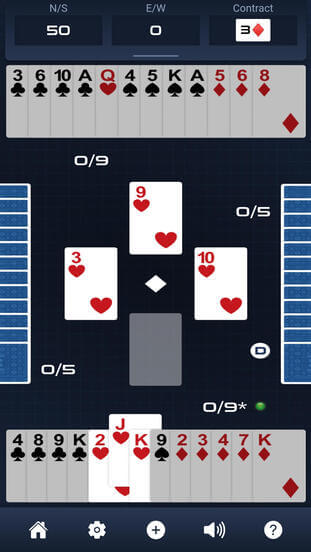
See it in action
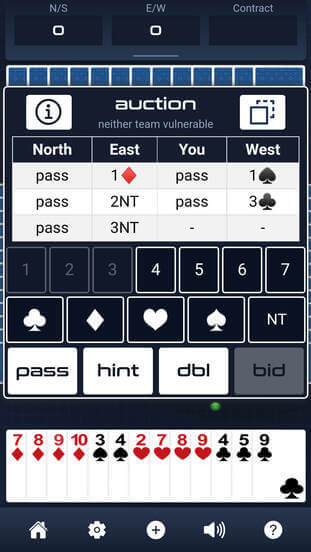
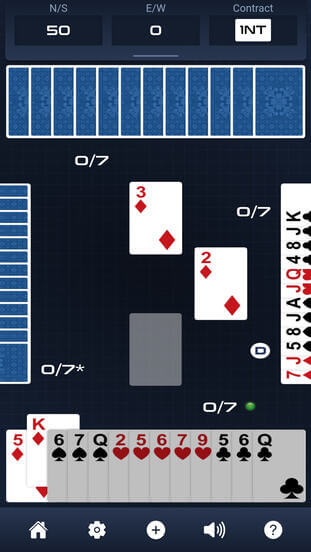
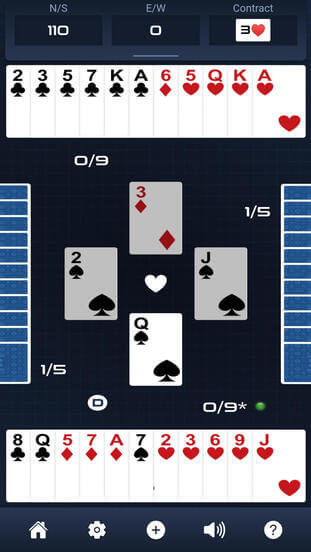
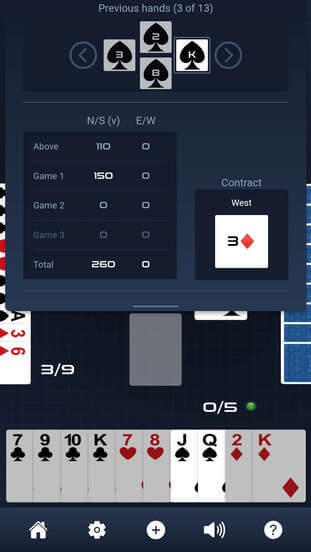

Get the app
Keep Bridge handy
Practice Standard American bidding with optional hints, hand review and replays.


Bridge Terms
How Your Partner Plays
Bidding
- Hand evaluation is based on the 4-3-2-1 point count system (Ace=4, King=3, Queen=2 and Jack=1) with adjustments for the location of honors and suit distribution.
- A hand-strength requirement of at least 12-13 points to open 1-of-a-suit.
- Five-card majors: opening a major suit promises at least a five-card holding in that suit.
- Weak two bids: Two Diamond, Heart or Spade openers are made with a sound six-card suit in a hand without enough overall strength to open 1 of the suit. The suit must contain two of the top three honors (Ace, King, Queen), or three of the top five honors (Ace, King, Queen, Jack, Ten).
- Strong two Clubs: All unbalanced hands too strong to open at the one-level are opened with an artificial 2♣ call, as well as balanced hands stronger than 21 HCP.
- Pre-emptive opening bids: Suit openings above the two level are pre-emptive, promising a long and strong suit. A three-level opening normally shows seven cards and a four-level opening eight cards, with the same top-honor requirement as a weak two bid.
- Limit Raises: A jump-raise of the opener's suit by responder, in the absence of opponent interference, is invitational to game.
- Notrump openers show a balanced hand, with the following common high card point (HCP) ranges:
- 1NT=15-17 HCP
- 2NT=20-21 HCP
- 3NT=25-27 HCP
General Play
- With the opening lead, your partner will lead a card from a suit you bid during the auction (if any), a suit that was unbid by the opponents, or lead a suit they are strong in.
- They are watching your response to their leads. If you play a low spot card (2-6), they assume you want them to stop running the suit, and if you play a high spot card (7-10), they assume you want them to continue. A second spot card higher than your first also says continue; lower says stop. This works for suits you showed in the auction too — a discouraging card in your bid suit tells them to stop leading it.
- They read a low card (10 or below) you lead in a side suit as asking for that suit back, and will try to return it where possible — until you show you are out of it.
- If they spot that you are void in a suit they will run that suit to give you the opportunity to trump (when there are trumps)
- In NT contracts, they will attempt to establish winners in suits they are strongest or longest in.
Strategy Tips
- Start with high-card points, distribution, and any fit with partner: Bridge bidding is about the combined partnership hand.
- Prefer a five-card major when opening where the bidding system supports it, and show confirmed support early.
- As declarer, plan before the first trick: count likely winners in no trump and likely losers in suit contracts.
- As a defender, use the auction and cards already played to infer suits, strength, and likely distribution.
- Treat doubles carefully: their meaning depends on the auction and may be takeout or penalty.
- Use the optional bidding hints to understand how Coppercod interprets the current auction.
Bridge FAQs
Can I play Bridge online free here?
Yes. Play Bridge online free in your browser or offline in the apps. No account or sign-up required.
Is this Rubber Bridge or Duplicate?
Rubber Bridge with traditional scoring. Practice bidding and play at your own pace against smart AI.
Which bidding system do the AIs use?
Standard American with common conventions like Stayman, Jacoby Transfer, and Blackwood.
Does it work offline?
Yes. The apps work completely offline against AI-perfect for practice anywhere.
Are there hints or tutorials?
Optional bidding hints and difficulty levels help you learn or sharpen your game.
What devices can I use?
Play in your browser on desktop or mobile, or download on iOS and Android.
Can I claim the remaining tricks?
Yes. Claim tricks is on by default and lets you claim the rest of the hand when all of your remaining cards are guaranteed winners.
Does Bridge have auto play?
Yes. Auto play can play your card on the last trick, or whenever you have only one legal move.
Can I review hands after each round?
Yes. You can review bids, review tricks, replay hands, and show the starting hands of all players after each round depending on your settings.
Are there readability options for cards?
Yes. Bridge includes mobile cards with larger numbers, four-color suits, 30 deck designs, and 17 themes.
How To Play
Deal
Bidding
Play
Scoring
Settings
Interface
During a game
Play other classic card games
Canasta , Bid Whist , Gin Rummy , Classic Whist or Euchre !